
Leading Workshops
What is their purpose? And would you like some groats with that?
Hello, friends,
When I was getting serious about trying to make a living from painting, when it first seemed like it was even possible, my friend, the quietly amazing Eric Aho, said, in passing, “why don’t you teach a couple of workshops?” At the time, that felt sort of akin to him saying “why don’t you fly to the moon?”
Lo and behold, twenty years later, here I am, having taught scores of workshops. Amazing! The five-year-old me would be amazed that anybody cares to hear about how I smear pigment on flat surfaces to create images that hopefully evoke an emotional reaction from the viewer. The slightly-grandiose young adult me would be pleased to learn that an eminence grise version of me would be imparting wisdom to eager students. And the actual me sits and wonders exactly what is the purpose of workshops?
The usual set up is that a local arts group invites a visiting artist to come teach. Compensation is negotiated (price, what percentage of registration fees go to the artist and what to the sponsoring organization, minimum and maximum group size, possibe inclusion of lodging, meals, and/or transportation) and both the organization and artist are expected to promote the workshop. The problem is that in-person art workshops are a hybrid beast that serve multiple masters. Aside from a desire to impart knowledge, the artist is hoping to make some money, and the sponsoring organization is hoping not to lose money.
This results in the primary motivation of both parties inadvertently but inevitably becomes a desire to fill the workshop; the sole criteria for inclusion is ability to pay, with the net result becoming a wildly divergent set of expectations amongst the class participants. A workshop can easily include:
Someone who has never painted before, but thinks it might be fun to learn.
Someone who is a follower of the specific instructor and is hoping to learn specific techniques.
Someone who takes pretty much every workshop the organization offers and is seeking their own “voice.”
Someone who just enjoys taking workshops recreationally with their friends.
Someone who is serious about their work and may have taken academic classes, but the instructors were far more interested in conceptual art than in representationalism, and so consequently they may be weak in certain fundamentals.
To try to impart actual, useful knowledge over the course of a few days to each person in such a group (and many workshops get as large as 16 participants) is virtually impossible: students are either left in the weeds (too much information! too little time!) or are left scrounging for bits of sustenance (I already know how to shade a cone, thank you!).
That’s why, over the course of the last couple of years, I have severely limited the number of workshops I do, and I am adamant about keeping group size to no more than 12. I now pretty much only do either:
Juried multi-day workshops (potential participants submit a portfolio and a statement about why they want to take the class and where they are in their journey). Admissions are selected from pool of completed applications.
Open single-day workshops (first dozen people who pay are in).
This year, the nine-month online Painters’ Path workshop I’m doing with Jason Sacran or the five-day Fryer/Hunter Gathering that I do with Doug Fryer (this year in Spring City, Utah) are examples of the first. The three one-day workshops I’m doing in Vermont (the first has already occurred, the other two are coming up - June 14 in Manchester and August 30 in Jeffersonville) are examples of the second (I think both those workshops have like one space remaining in each one, but you should ask).
I do also do the very occasional multi-day unjuried workshop. I find multi-day open-admission workshops very tiring because I genuinely wish to impart information, and having to calibrate one’s teaching to each participant’s ability as best one can over the course of three days is pretty emotionally exhausting. But, candidly, getting out of Vermont in February is a strong motivator, and the Scottsdale Artists School is a really well-run institution with a fantastic sense of mission and purpose. And I can combine that with a good, long train ride, a chance to paint with friends in Big Bend, and a nice visit with my beloved in Texas (which also means barbeque and excellent live music).
But what to teach? I’ve fiddled and faddled with the curriculum over the years - what I’d really like to teach is The Importance Of Developing A Sketching Process (and, believe me, just about every one of my fellow artists would like to teach the exact same topic), but the reality is that people do not want to take that workshop one bit.
Put it this way: do you want to spend your disposable income on dried groats or on a gorgeous chocolate eclair?
So, the challenge is to make an eclair that actually has some nutritive value. I asked Jason for help, and here’s what he helped me build:
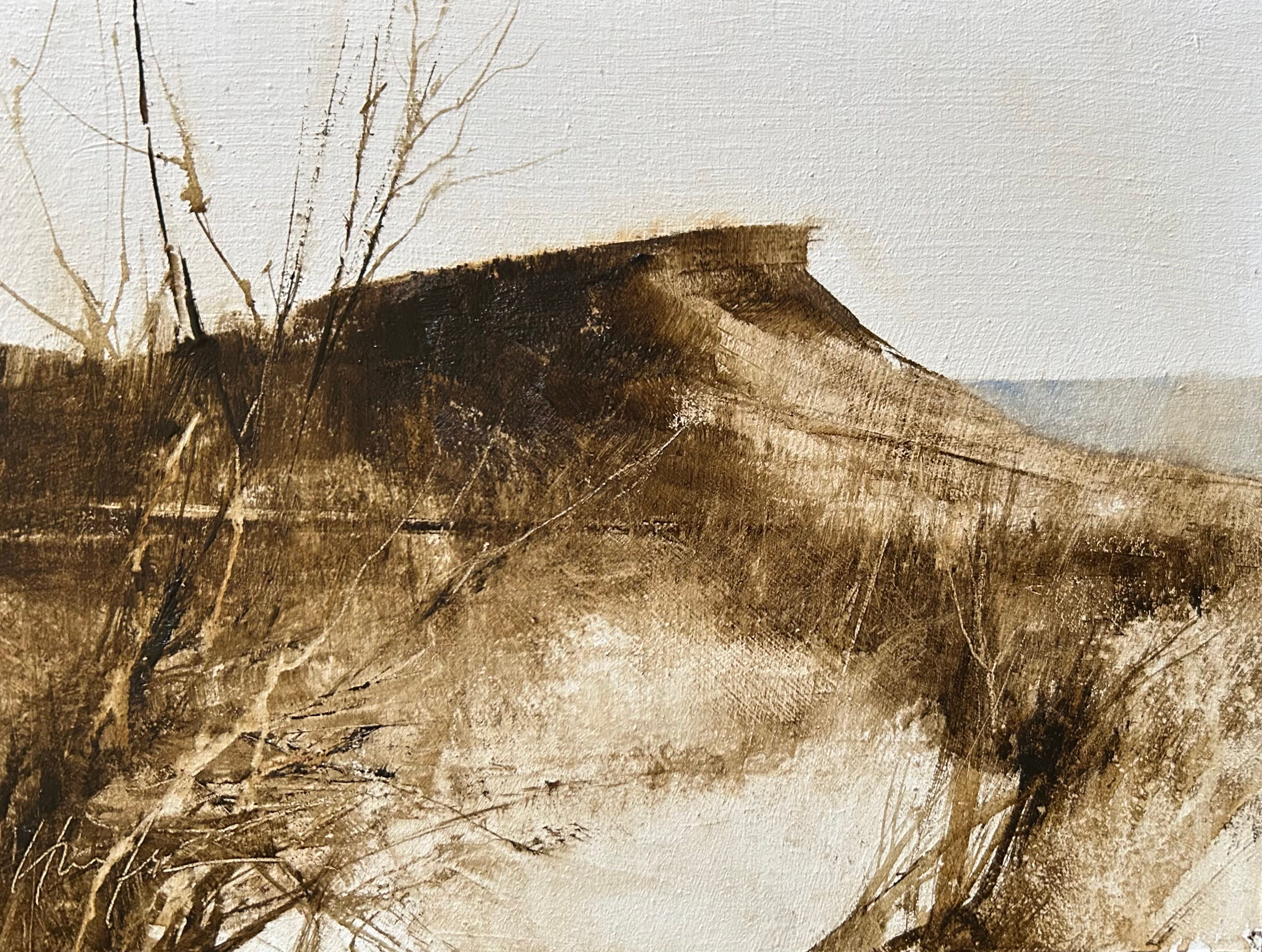
Things of God, Things of Man: The Low-Chroma Landscape
February 23-25, 2027/ Tuesday-Thursday, Scottsdale Artists School, Scottsdale, AZ
Charlie Hunter’s landscape paintings capture the quiet, melancholic beauty of “rural deindustrialization” using a near-monochromatic, modified tonalist style that feels both timeless and deeply personal. His work is acclaimed for distilling complex scenes into essential, moody compositions that blend photographic realism with abstract, textural mark-making. For this workshop, each day’s class begins with a demonstration painting in which Hunter explains the decisions and choices made as the painting evolves. Students then work on their own, with an emphasis on design, mood, and finding one’s true “voice,” before all gather for lively group critique and discussion. Sketching to work out compositional challenges, use of water-mixable oils and unorthodox tools such as window washer’s squeegees, patterned paper towels, and washes of thin paint to create unique, almost photographic textures are all discussed. Experimentation and laughter is encouraged.
How does that sound to you? Sure, it’s a bit of a catch-all, but as Jason pointed out, I’m now known enough that people want to learn more about the thought process behind the paintings, and not just about the way I use -say- a plant sprayer or Stim-U-Dents in creating a piece.
Well, we will find out. I’d love to hear your thoughts and experiences about leading or participating in workshops - that’s part of what I like about Substrate; the comment section allows for an actual conversation.
A reminder that tomorrow I am going to post the May Absurdly-Discounted-Original-Painting to our paid subscribers. Beneficiary this month is Alex MacDonald, a very good painter, who is engaged in a seriously demented fundraising walk from Land’s End (the most southerly point in England) to John O’Groats (groats again! and the most northerly point in Scotland), a distance of 1250 miles, for the UK charity, WAR CHILD. Details on Alex’s fundraiser here.
Thanks again for your interest in my work. It is deeply appreciated.
~ Charlie
Maybe you’d like to become a paid subscriber?
We wouldn’t say no.
All proceeds from those discounted paintings go to charity.
I realize this is like the second time I’ve written about workshops. Apparently I obsess about this topic quite a bit.
As a person who is asked to "teach a class" occasionally, and been reluctant and nervous, who is also enrolled in your Hunter/Fryer workshop, I very much look forward to discussing this further, in person.